In this story
After lithium-ion battery (LIB) fires, Orange County Fire Authority (OCFA) crews in California found their gear could go through the extractor five times and "still stinks and has film." The duty uniforms worn underneath looked contaminated too. An energy storage system (ESS) fire in 2023 had already pushed the department into lab testing of its gear.
The care standard, National Fire Protection Association (NFPA) 1850, now asks departments to weigh battery involvement when they choose a cleaning level. Under Tentative Interim Amendment (TIA) 26-1, after an LIB or ESS fire the department has to make a deliberate call between advanced cleaning and specialized cleaning instead of sending everything through the extractor by default.
On the apron
That call starts before anyone takes off a glove. Stay on air through overhaul and gross decon. The International Association of Fire Fighters (IAFF) calls not wearing self-contained breathing apparatus (SCBA) in both active and post-fire environments "the most dangerous voluntary activity in the fire service today."
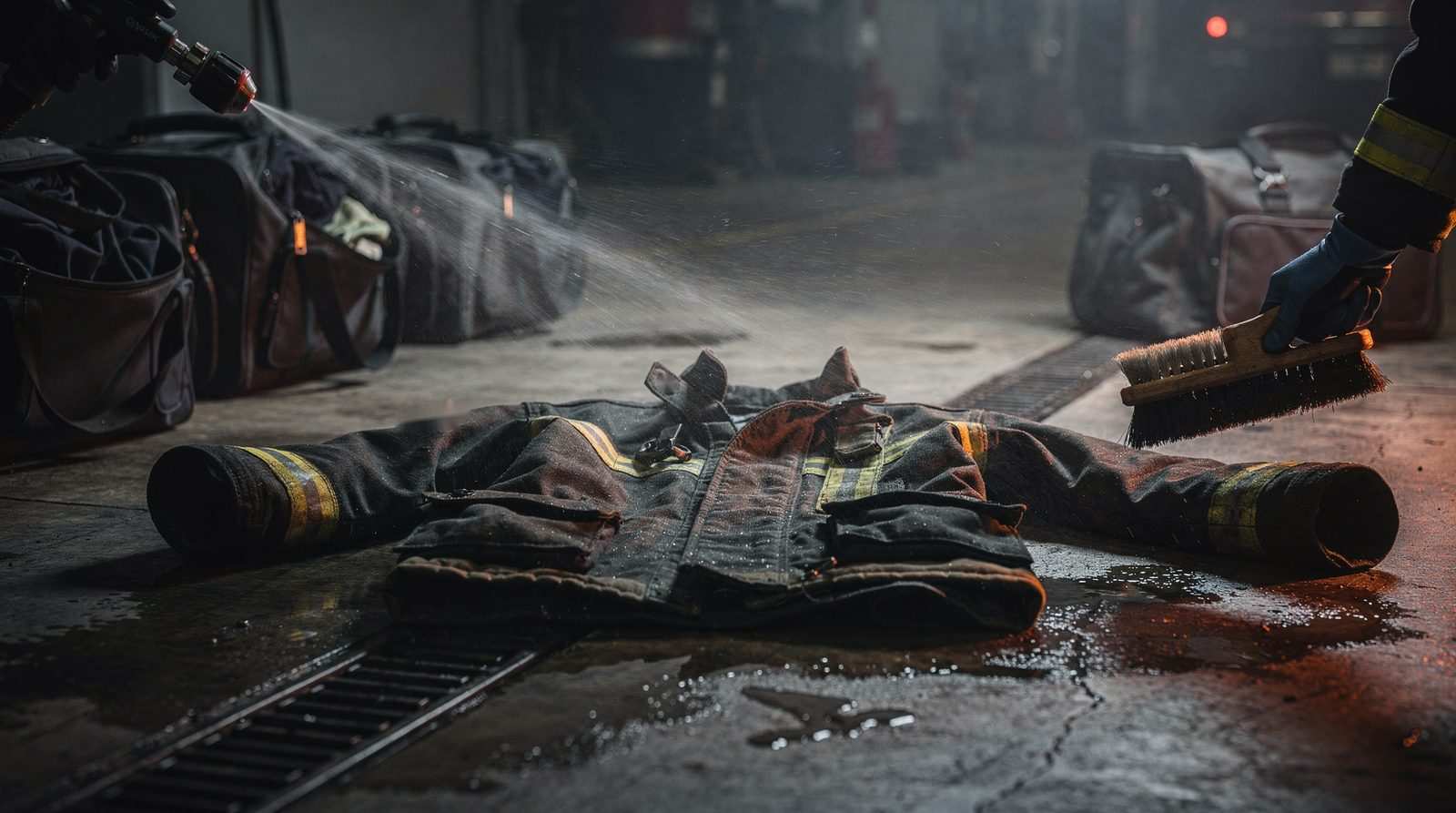
Soap and scrubbing do most of the on-scene work. In controlled residential fires studied by the National Institute for Occupational Safety and Health (NIOSH), a dish-soap field decon cut polycyclic aromatic hydrocarbon (PAH) contamination on turnout jackets by a median of 85%; dry brushing cut it by about 23%. Cleansing wipes cut PAHs on neck skin by a median of 54%.
Preliminary exposure reduction (PER), as the IAFF lays it out:
- Mark a decon area with a cone and bucket.
- Stay on air; the members lowest on air decon first. Scrub with soap and low-flow water. Don't saturate liners, and do the boot bottoms.
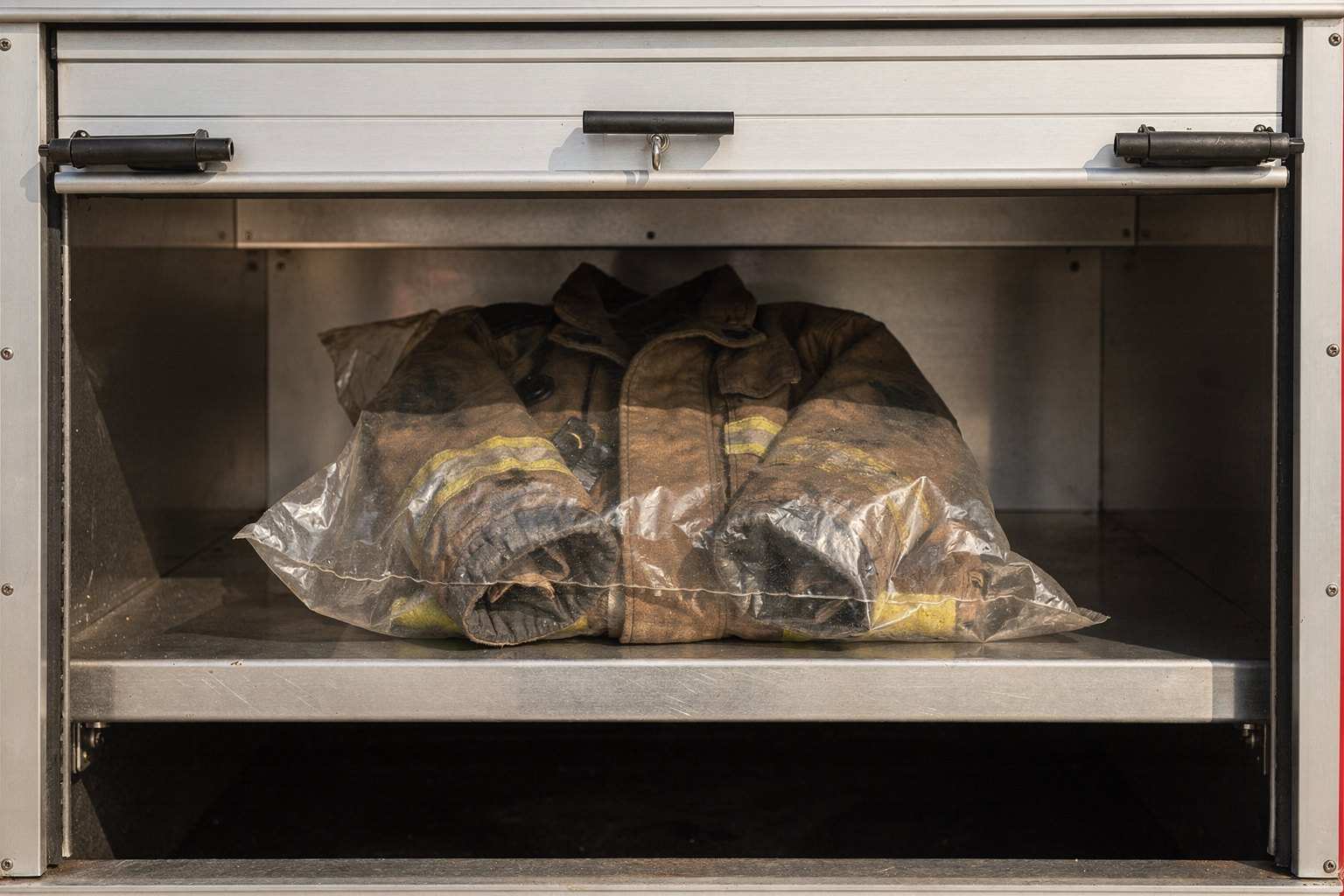
- Designate a doffing area. Bag and seal personal protective equipment (PPE) in leak-proof bags and carry it in an outside compartment, never the cab.
- Wipe exposed skin, then go to rehab.
- Shower within the hour and change into a clean second set if you have one.
If cold weather forces dry brushing, write it down and plan a stronger clean back at the station.
What's on the gear transfers to whatever it touches, skin included, according to NIOSH. If bagged gear did ride inside, decon the cab. Keep gear out of personal vehicles and homes, and store it where the exhaust discharges outdoors. SCBA comes off last and goes on its own cleaning track (straps, harness, bottle exterior and facepiece) under the manufacturer's instructions and your standard operating procedures (SOPs).
Advanced or specialized cleaning?
The standard lists seven factors. Here they are as questions an officer can answer on scene:
- How much of what burned was battery? A burning e-bike in a living room and a laptop in the debris field are different events.
- Was it open or closed, such as an electric vehicle (EV) in a garage? The standard says closed environments are more likely to load the crew harder.
- Who was close, and for how long? Start with the attack and overhaul crews.
- Did any readings show contaminants tied to battery decomposition?
- Has your department, or a neighbor on a similar fire, seen ordinary advanced washes fail before?
- Is there independent data showing a particular process removes battery-fire contaminants?
- Can you test the worst-exposed gear before and after cleaning?
If most answers are yes, or they point to heavy LIB exposure, the Urban Fire Forum's (UFF) rule of thumb is to go beyond ordinary washer/extractor cleaning.
| Level | What it is | When it fits |
|---|---|---|
| Preliminary exposure reduction | On-scene rinse or light clean of exterior soils | Every exposure to smoke or products of combustion |
| Advanced cleaning | Thorough machine-based clean (washer/extractor for most soft goods) aimed at ordinary fire soils | Low LIB proportion, short or open exposure, no adverse measurements, known good results with the current process |
| Specialized cleaning | Agents or processes beyond advanced cleaning for difficult or unusual contamination | High LIB load, closed environment, long work close to the fire, adverse measurements, failed prior advanced cleans, or supporting independent data |
Liquid carbon dioxide (CO₂) cleaning and enhanced CO₂ processes are the specialized options the UFF and the annex describe. The machines are expensive and hard to get to.
The organics get into the moisture barrier
In a test chamber at the Texas A&M Engineering Extension Service, researchers drove batteries into thermal runaway with bunker gear swatches and SCBA straps hung in the smoke. The outer shell stopped most of the metal particles before they reached the moisture barrier, and both cleaning methods removed more than 99% of them, though some cobalt, manganese and lithium stayed in the gear either way. The semivolatile organic compounds (SVOCs) got through the shell and built up in the moisture barrier. Water-based cleaning removed between 21% and 92% of them, depending on the compound. Liquid CO₂ left many below detection.
Those organics in the inner layers are the reason to send heavily exposed gear for CO₂ cleaning. When the size-up is mixed or uncertain, send the gear for specialized cleaning too. The standard doesn't require that; we'd do it anyway.
Download the printable decon card Print page
- Run the PER steps first, including bagging and the separate SCBA track. If PER hasn't been done, stop and do it.
- Work through the seven questions and use the column where most answers land.
| Mostly low concern | Mixed or unsure | Mostly high concern | |
|---|---|---|---|
| What to do | Advanced cleaning per SOPs; return to service after a successful clean | Default to specialized (or enhanced advanced) cleaning, unless verification or peer data justify the advanced path | Specialized cleaning |
| Documentation and testing | Document LIB involvement on the work order | Record the verification results or peer data if you choose the advanced path | Consider destructive pre- and post-cleaning testing on the worst-exposed set |
Before the next battery fire
In New York, where the Fire Department of the City of New York (FDNY) was fighting about three lithium-ion battery fires a week in early 2023, Uniformed Firefighters Association President Andrew Ansbro pressed the department to clean bunker gear after every one. "They shouldn't be taking the dirty gear from these fires and bringing it back to the firehouse," he told the New York Daily News. An FDNY spokesman said its cleaning policies already exceeded national standards. Members there are issued two sets of gear.
What a PPE program manager should have in place:
- Second sets. Without a clean spare, bagged gear takes a member off the rig.
- PER kits on every rig: soap and scrub brushes, a low-flow water source, leak-proof bags, nitrile gloves for packaging, and skin wipes.
- A specialized cleaning contract. Map the independent service providers (ISPs) in your region that offer CO₂ or enhanced cleaning. The UFF points to the Federal Emergency Management Agency's Assistance to Firefighters Grant (FEMA AFG) program and regional facilities when a department can't buy the equipment itself.
- An SCBA pathway. SCBA straps were in the test chamber too, so specify a process for harnesses and straps before someone improvises in the bay sink.
- A testing plan. Pick the lab and the analytes (lithium, cobalt, nickel, manganese, SVOCs and PAHs) ahead of time, and decide when a set gets cut up for sampling.
- Wastewater. The TIA also tightens rules on washer effluent, including per- and polyfluoroalkyl substances (PFAS). Budget for monitoring and treatment where required.
- Training. The UL Fire Safety Research Institute (UL FSRI) ESS course and the IAFF's battery and energy storage program cover closed-space battery hazards. Add a contamination-control drill.
Proving the clean
Wipe samples from the outside of a coat miss what has worked into the layers. The annex says so, and OCFA found the same. Test the dirtiest set before and after cleaning. A fair baseline may mean cutting one garment in half, and that costs a set of gear.
No standard test exists yet, and nobody has agreed on a number for clean enough, so the department decides when exposed gear goes back in service, with outside help where it needs it. Size up the gear as deliberately as the building, and test when the exposure was bad enough to justify it.
Sources (12)
Sources
- NFPA, TIA 26-1 to NFPA 1850 (2026 edition).
- NIOSH Science Bulletin, Protecting Firefighters from Contaminated Gear (2026).
- IAFF / FCSN, Reduce Your Exposure (2026).
- Fent KW et al., Contamination of Firefighter Personal Protective Equipment and Skin and the Effectiveness of Decontamination Procedures, J Occup Environ Hyg. 2017;14(10):801–814.
- IAFF / FCSN, Exposures to Carcinogens (2026).
- IAFF, Training Brief: Preliminary Exposure Reduction / Gross Decontamination.
- Urban Fire Forum, Statement in Support of Considering Enhanced Decontamination Methodologies of PPE Following Exposure to Lithium-Ion Battery Fires (2024).
- Brian Fennessy and Jeffrey O. Stull, Decontamination Considerations for Lithium-Ion Battery (LIB) Fire Exposure, Urban Fire Forum presentation (2024).
- TEEX, Lithium-Ion Battery Fires and Emissions Characterization Report.
- FireRescue1 / New York Daily News, Union to FDNY: Do more to guard FFs from e-bike fire smoke; it may be as risky as 9/11 toxins.
- UL FSRI, New Online Training: Fire Service Considerations with Lithium-Ion Battery ESS.
- IAFF HazMat Training, Responding to Battery and Energy Storage Emergencies (REE).