In this story
- Officer habits that invite a challenge
- How should a member raise a concern?
- The five-part safety call
- The stop call
- Three hands out of more than 50
- Drill 1: Script reps
- Drill 2: Officer under load
- Drill 3: Cross-monitoring walk-through
- Drill 4: The officer-is-wrong tabletop
- The blame-free after-action review
- Company officer checklist
- Sources
A career firefighter died on Sept. 8, 2025, at a Georgia warehouse being used as an unpermitted film studio. Crews went in on a residential-style offensive attack before a 360 was finished and before there was a water supply. National Institute for Occupational Safety and Health (NIOSH) investigators who interviewed members afterward wrote:
"During interviews with NIOSH, some firefighters expressed that they did not agree with and had concerns about the initial strategy chosen by Engine 14 and the ongoing interior operations. However, they cited department culture as being a barrier to speaking out."
Many firefighters told investigators that a residential strategy was used from the start and "did not change until conditions deteriorated significantly." The seventh recommendation in the report, F2025-09, asks departments to build a professional development program "that promotes psychological safety, with a focus on open safety communication during incidents." For the warehouse tactics from the same report, see the warehouse first-due playbook.
The report defines psychological safety, after management researcher Amy Edmondson, as a shared belief within a team "that it is safe to speak up with ideas, questions, concerns, or mistakes without fear of retribution or embarrassment."
The crew still doesn't vote. In NIOSH's example, an engine officer busy before entry misses fast-changing smoke, a crew member who feels safe calls it out, and "it was ultimately up to the officer to apply the observations of the crew." The International Association of Fire Chiefs (IAFC) says the same of its Crew Resource Management (CRM) manual: "The leader retains ultimate authority but includes crew input for better outcomes."
Officer habits that invite a challenge
Members decide whether to speak up based on what happened the last time someone did. According to NIOSH, it takes "humility and openness, strong situational awareness, communication to supervisors without fear of retribution for doing so, and leadership valuing those observations." At the company level that looks like this:
- At the rig, before entry, ask "What are you seeing that I'm not?" Ask it every time so it never sounds like doubt.
- Name your blind spot out loud: "I'm on the radio. You're my eyes on the smoke." Now one person has one thing to watch.
- Say "Good call, thanks" before you answer a concern, even when the answer is that you're staying. A joke or an eye-roll teaches the whole crew to keep quiet.
- If you don't act on a report, tell the member why once there's time. When the newest firefighter calls something and turns out to be wrong, the answer in front of the crew is still "keep calling it."
- Hand out jobs by skill. If your best thermal imaging camera (TIC) operator is the junior member, they carry it.
How should a member raise a concern?
A concern raised as a hint ("Kinda smoky, huh?") often gets lost. The CRM manual gives two clearer tools, matched to how much time there is.
The five-part safety call
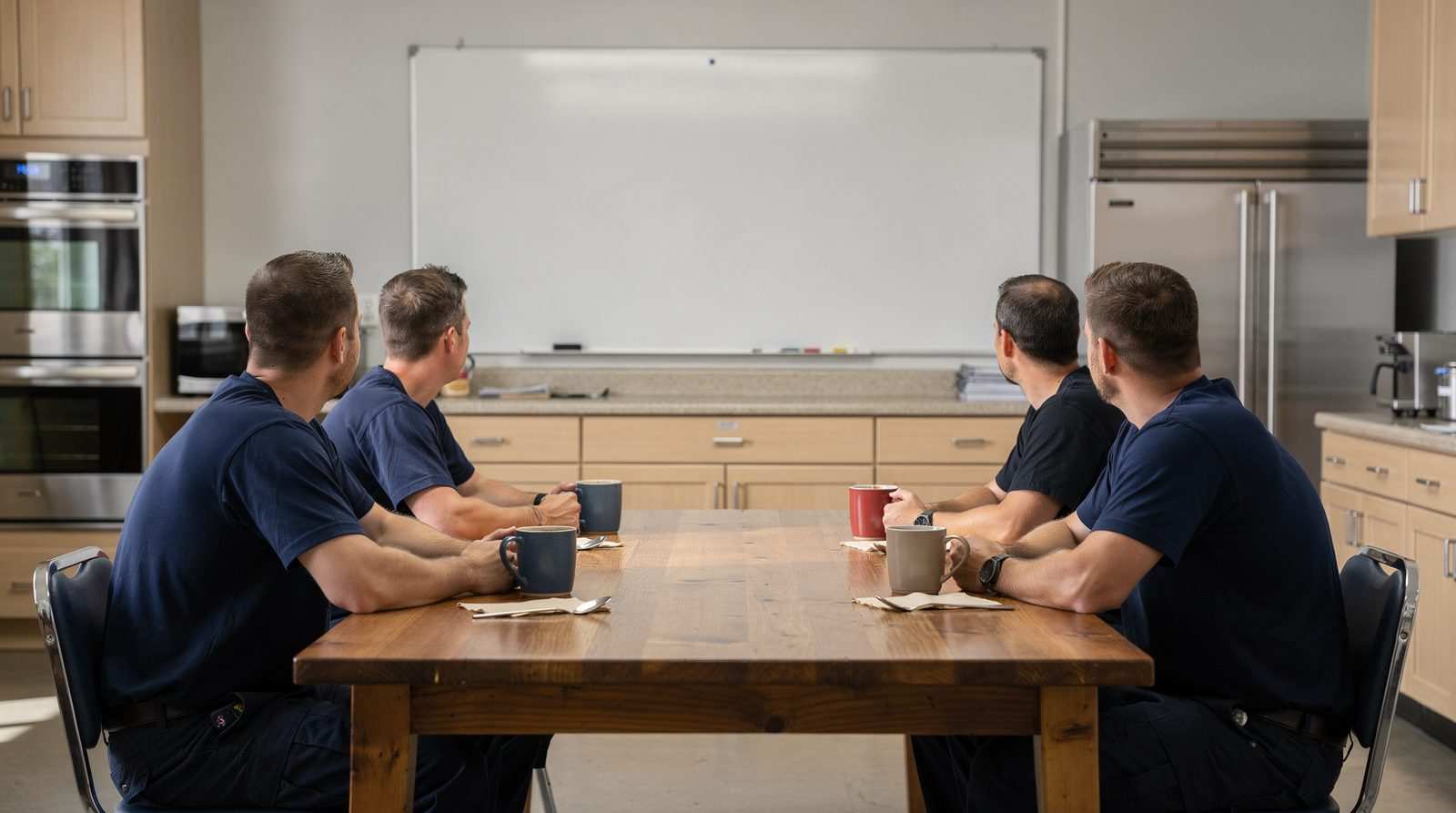
The call adapts the five-step assertive statement that Todd Bishop developed and the manual teaches. The manual says to use it "where risks are low, time is not a factor and lives are not in danger," such as during size-up or while the plan is still forming. In this example, a truck crew is going over a preplan at the kitchen table.
If a member has a concern but no fix, they still make the call. The manual is clear that a missing solution shouldn't stop anyone from pointing out a problem.
The officer has two acceptable answers: adopt it ("Good catch. Change the preplan.") or decline with a reason ("I see the lines. From the Charlie lot we can't reach the roof, so we'll keep Alpha and flag the lines on the plan.").
The stop call
When danger is real and immediate, there's no time for five steps. The manual calls the blunter option the "This is Stupid!" (TIS) technique and describes it as "the last tool in the toolbox." On the radio, it has four parts.
The Buckley (Wash.) Fire Department chose something stranger for its call sign. Chief Alan Predmore's crews "wanted a phrase that would be so unusual that the commander would have to stop and listen up," wrote Rich Gasaway, a former fire chief. They picked "The Pigs are Eating Lemons!" Whatever your crew picks, anyone can use it and the officer stops to listen. Put it in writing as a company expectation.
Three hands out of more than 50
In a class for wildland firefighters, Gasaway asked more than 50 hand-crew members, with their bosses out of the room, who would be comfortable speaking up if something was going wrong. Three raised their hands. Some had been taught about speaking up, but "not one student in the room had ever practiced the skill." His fix is practice: "Subordinates need to practice the script, in the first-person voice, to gain comfort with how to utter the words and how to overcome the inherent fear of defying an authority figure." He adds that "some bosses will also need to practice receiving this kind of feedback."
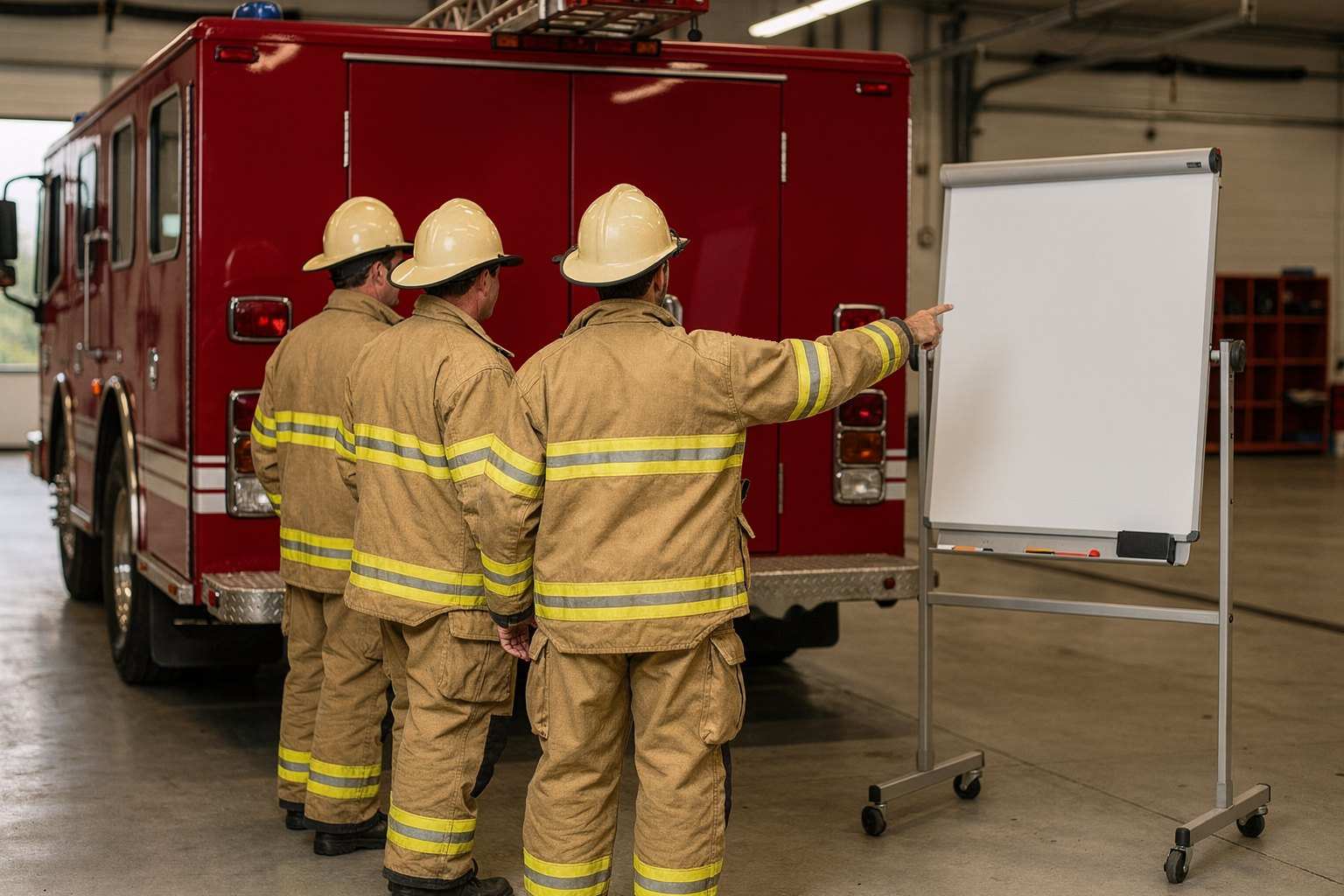
Short, frequent drills work best, the "sets and reps" approach the CRM manual describes. Keep each one to 20 to 30 minutes at the kitchen table or on the apron.
Drill 1: Script reps
- The officer reads a one-line change, such as "the preplan puts the engine in front of the only hydrant" or "your partner's self-contained breathing apparatus (SCBA) low-air alarm just went off."
- Each member picks the five-part call or the stop call to fit the cue and makes it out loud, in the first person, to the member on their left, who plays the officer and adopts or declines with a reason.
- Rotate until everyone has made at least three calls and answered three. Repeat weekly for a month, then rerun it with one other drill every quarter or whenever new members arrive.
Drill 2: Officer under load
During a non-live-fire evolution, bury the officer in simulated radio traffic or a tactical worksheet while the instructor quietly hands one member a card with a hazard cue, such as "you see fire under the door to your right." Note how fast the member calls it, if at all, and how the officer answers, then repeat with a different member holding the card.
Drill 3: Cross-monitoring walk-through
Give each member one thing to watch for the whole evolution: smoke, air, the hoseline or the exit. At the end, each member reports on their area and the officer says what they missed.
Drill 4: The officer-is-wrong tabletop
Present a simple scenario in which the officer makes a plainly poor call. Crew members challenge it with the script, and the officer practices taking the challenge well. Rotate the officer role all the way down to the probationary member. The scenario should never put anyone in real danger.
The blame-free after-action review
Crews learn from a bad call only if they can talk about it. The NIOSH report recommends "debriefing training, activities, and other discussions about what went wrong to learn lessons for the next incident." Keep it to about 15 minutes, soon after the call or drill.
Read the ground rules aloud each time:
- We're talking about what happened, not who's to blame.
- Rank stays at the door. The officer goes first and last.
- What's said here is for learning. Anything that needs a formal process goes there separately.
Then work through five questions in order.
The officer closes by naming one thing they'll do differently and thanking a member for a call they made. Write down the lessons without names.
Company officer checklist
- Read NIOSH F2025-09 Recommendation #7 with the crew.
- Download the CRM Manual, 4th Edition, and print a station copy.
- Adopt the five-part call and a stop phrase as company expectations.
- Run Drill 1 weekly for four weeks, then quarterly, and Drill 2 at the next non-live-fire evolution.
- Hold the five-question review after every working incident and drill this month.
- Count question 4 answers, with no names, to see whether speaking up is increasing.
- Ask your chief whether the professional development program covers psychological safety.
The firefighters in Georgia who doubted the plan kept it to themselves. Start this month with Drill 4, with yourself as the wrong officer, and keep asking question 4 until the answers stop coming back "nothing."
Sources (5)
Sources
- NIOSH, Career Firefighter Dies during Warehouse Fire at Unpermitted Film Studio – Georgia, Report F2025-09.
- IAFC, Crew Resource Management (CRM) Manual, 4th Edition.
- IAFC, Stronger Communication, Smarter Decisions, Safer Firegrounds: New CRM Manual Released.
- IAFC and NFFF, Crew Resource Management: A Force Multiplier for Better Critical Fire Service Decision Making, 4th Edition.
- Rich Gasaway, The Art of Speaking Up, Situational Awareness Matters.