In this story
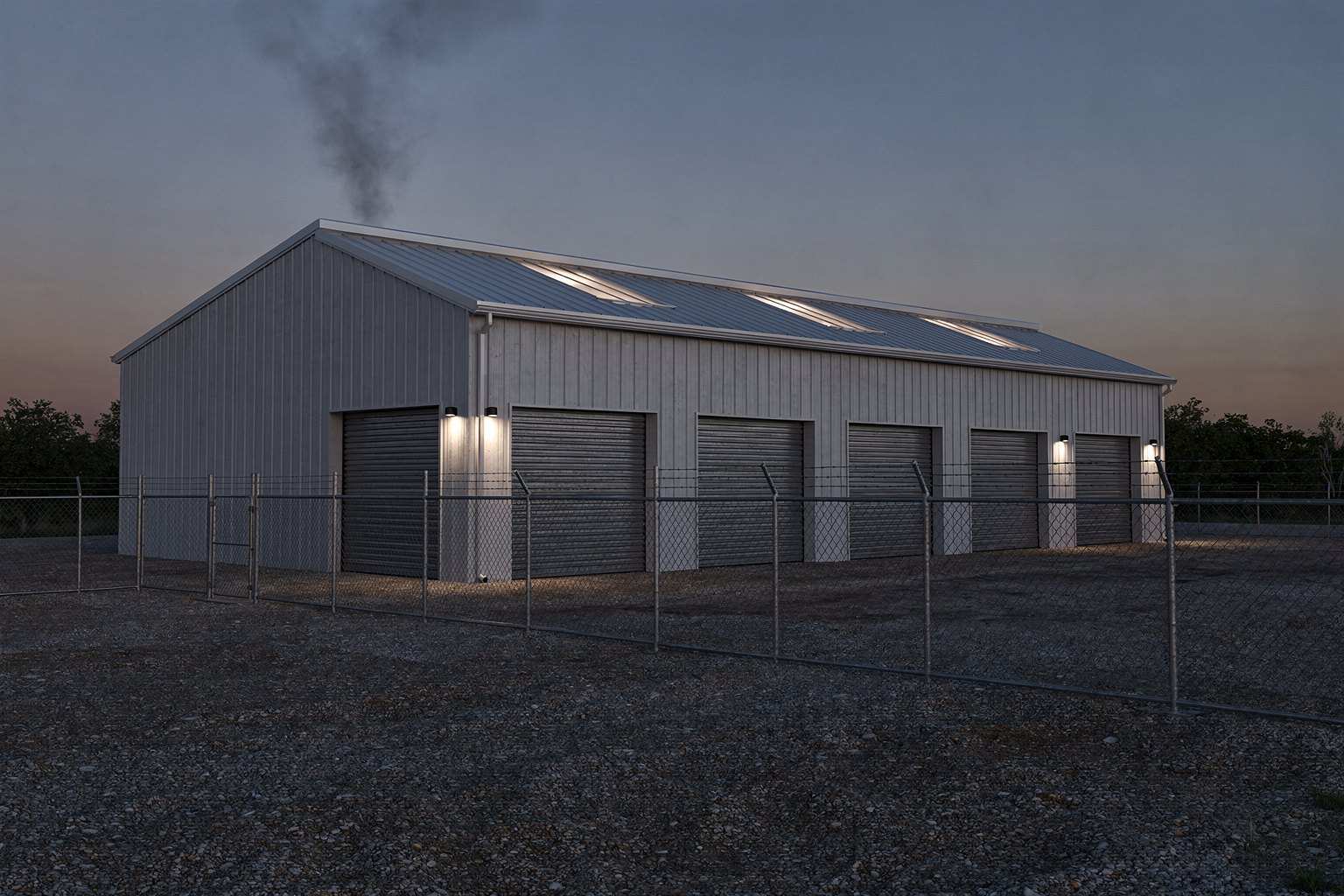
The building in DeKalb County, Georgia, looked like a one-story metal warehouse of about 70 by 200 feet, with seven 14-foot garage doors on two sides and a fenced two-acre lot. Its last fire inspection, in 2017, listed it as car-parts storage. Since 2019 it had been a film studio, never permitted for that use, with its interior built out into themed rooms made of polystyrene foam board. Fire Safety Research Institute (FSRI) data cited in the report puts that foam's heat of combustion 50% to 100% above wood's. The first engine arrived with three people and stretched 200 feet of 1¾-inch line. Vegetation stopped the officer from finishing the 360, and the hydrant in front of the building could not be opened. Garage doors went up for lift before water was on the fire, with a 9 mph east wind (gusting to 21) blowing toward the open Side Alpha.
When a quint crew got lost inside, a heavy rescue crew went in after them. One of its members, Master Firefighter Preston Fant, a 21-year veteran, was separated from his partner on the way out, became disoriented and died. The National Institute for Occupational Safety and Health (NIOSH) investigated the September 2025 fire as report F2025-09. Tony Pritchett, Georgia's deputy safety fire commissioner, told WSB-TV, "You kind of have a lot of cards stacked against them from the beginning." Of the building itself: "It was unpermitted, unlicensed, of course, so therefore the local jurisdiction had no clue."
Many firefighters told NIOSH investigators that "a strategy for residential structure fires was employed at this incident initially and did not change until conditions deteriorated significantly." At a commercial shell, we think the first-due officer's most important call comes before the first line goes through the door: whether this is a house-scale problem at all.
A warehouse fire is a complex incident with a high fire-flow demand and a real chance of disorientation, as National Fire Protection Association (NFPA) 1700 describes it. Six cues on size-up say you are in one. Any single one is enough, including a water picture that looks thin from the cab: no visible hydrant, a private one of unknown status, or a long large-diameter hose (LDH) lay.
The first officer's arrival report covers construction type, occupancy cues, smoke and fire location, wind and mode (offensive, transitional or defensive). It says whether the 360 is complete, and if it isn't, assigns the next unit to finish it and report conditions, actions and needs (CAN). Call for a 2½-inch line when fuel load and area demand it, not a single 1¾-inch residential stretch. Then say three benchmarks aloud and keep updating them: water supply established or not, fire located or not, ventilation coordinated or pending. If residential habits are already in motion and the building reads as high-risk, change the plan out loud.
Some firefighters at the Georgia fire disagreed with the initial strategy but, as they told NIOSH, "cited department culture as being a barrier to speaking out." NIOSH recommends professional development that makes it safe to question strategy and report deteriorating conditions without fear of retribution. Invite challenge on mode and water during size-up; our crew resource management (CRM) field guide has the scripts and drills.
How much water before going deep?
Get an adequate water supply early and hold it; NFPA 1700 makes that a warehouse priority. Tank water alone won't carry a deep interior attack in a commercial shell, especially when several companies will need lines at once for attack, backup and exposures.
| Priority | Who | Action |
|---|---|---|
| 1 | First engine | Size-up, secure access, stretch appropriate line staged at a safe entry point; report water status |
| 2 | Second engine / water company | Positive water supply (street hydrant, LDH, alternate hydrant if private fails); announce “supply established” |
| 3 | Attack crew | Advance only after supply is confirmed or the incident commander (IC) has explicitly authorized a limited, coordinated transitional/exterior hit while supply is finishing |
| 4 | Backup line | Stretch early; warehouse travel distance eats hose |
Until supply is confirmed and the fire located, work from openings of relative safety and have defensive streams or monitors ready in case the fire vents through the roof.
Garage doors wait on fire control
The Georgia fire was ventilation-limited on arrival, and NIOSH found that opening doors moved it from decay to growth. Wind adds to the risk: winds as low as 9 mph, the speed that day, can speed up or redirect fire gases and produce a sudden, dramatic increase in fire, heat and smoke, according to NIOSH. Door rules for the officer or IC:
- Use existing openings (man doors, vents, skylights, fans) before cutting garage doors.
- Raise or cut a garage door only when an effective stream is ready or already flowing on the fire area.
- Assign who opens each door and when, and radio it: “Door 3 on Side Delta stays closed until water on fire.”
- If the wind is at your back into an opening, treat that opening as an inlet and plan exhaust and crew position around it.
- If the strategy goes defensive, evacuate the interior and roof and set and enforce collapse zones.
When the fire goes to all hands
In Georgia the fire went to all hands fast, and no fresh crew stood by when the Maydays came. NIOSH recommends an on-deck crew in a forward staged position outside the immediately dangerous to life or health (IDLH) atmosphere, ready for relief, reinforcement or rapid intervention, including a Mayday rescue. Designate it early, before the scene is “all hands.” Keep that crew in full gear with breathing apparatus ready and tools cached, and backfill it as soon as it's committed. At warehouse scale, on-deck runs in addition to a dedicated rapid intervention crew or team (RIC/RIT).
Command has to grow just as early. In Georgia, no formal transfer of command happened until the third incident commander took over. Build in:
- Formal transfer of command covering accountability, assignments, conditions, safety concerns and the three benchmarks
- An incident safety officer (ISO) separate from the IC and operations
- Division or group supervisors when the IC can't see all sides
- A staff aide or technician on the tactical worksheet and accountability
- Task, location and objective in every assignment
Interior crews give an early conditions report, then regular CAN updates; hazards go up the chain immediately. Busy crews won't volunteer perfect information, so ask for it and staff the command post to hear it. Since the fire, the department has added a strategic IC outside the hazard zone who works from a tactical worksheet.
Would your Mayday hold up under stress?
The department adopted a Who, What, Where (WWW) Mayday procedure in December 2023 and trained on it in 2024, yet NIOSH found that "Neither Mayday in this incident followed the WWW or industry best practices for declaring a Mayday."
In a large open or partitioned interior, stay in visual, voice or touch contact and don't split off from your company officer. If a member can't be accounted for on a personnel accountability report (PAR), call a Mayday. NIOSH notes that any delay lowers the chance of survival and raises the risk to rescuers.
Drill your Mayday format: declare early, use the emergency button or priority traffic, activate the personal alert safety system (PASS), and give air status and location. Command works from a Mayday tactical worksheet so key steps don't rest on memory. The International Association of Fire Fighters (IAFF) Fire Ground Survival program covers these skills and crew-based rescue.
A thermal imaging camera (TIC) won't always lead a lost member out; it needs thermal contrast. Poor scanning technique, high moisture, uniform temperatures, one-way flow paths and, rarely, radio-frequency interference all cause problems, NIOSH says. In Georgia, a lost quint officer's TIC screen whited out from oversaturation as he looked for the exit. Drill a low scanning position at a controlled speed, with an eye on lens moisture. Treat a white, no-contrast screen as a survival cue, not a way out, and have crews practice finding their way by hoseline, search line, wall, sound and radio.
A film studio with no pre-plan
Nobody in the department knew about the change of use. NIOSH wants pre-incident plans for high-risk occupancies, zoning and building officials who share occupancy changes, enough inspectors to enforce codes (the department had 12 people in planning and risk reduction for about 20,000 commercial occupancies), and local governments that consider requiring sprinklers.
A company-level pre-plan card should hold at least:
- Construction type, dimensions, roof and assembly notes
- Permitted versus observed use, with partitions, high-piled storage or props
- Public and private hydrants, fire department connection (FDC), and sprinkler and standpipe status
- Access: gates, fences, key boxes and apparatus placement limits
- Attack paths from openings of relative safety; collapse and exposure concerns
- A contact for the authority having jurisdiction (AHJ) on inspection history and out-of-service systems
This week:
- Pick two warehouses or commercial shells in your first-due.
- Walk the exterior and fill in the card.
- Check that computer-aided dispatch (CAD) and pre-plan data match the current use; flag any change to prevention.
- Brief the shift: “If we get this address tonight, water first, doors with fire control, on-deck early.”
Download the printable pocket card Print page
Drill plan (one shift)
| Block | Time | Focus |
|---|---|---|
| A | 20 min | Tabletop: 70-by-200-foot metal warehouse, seven garage doors, incomplete 360, failed hydrant, wind on Alpha doors |
| B | 20 min | Hoseline: LDH, 2½-inch vs. 1¾-inch, backup stretch distance |
| C | 20 min | Door coordination: hold / open triggers tied to “water on fire” |
| D | 20 min | Mayday: WWW or department format, crew integrity, TIC white-out |
| E | 15 min | On-deck / RIC rotation rehearsal |
| F | 15 min | Pre-plan walk of two targets or CAD review |
Sources (5)
Sources
- NIOSH FFFIPP, Career Firefighter Dies during Warehouse Fire at Unpermitted Film Studio – Georgia, Report F2025-09 (March 2026).
- NIOSH, Fire Fighter Fatality Investigation and Prevention Program.
- NFPA 1700, Guide for Structural Fire Fighting (2026).
- IAFF, Fire Ground Survival (FGS) & Fire Fighter Rescue Training.
- WSB-TV, Michael Doudna, Unlicensed movie studio didn't have safety features during blaze that killed firefighter (March 2026).