In this story
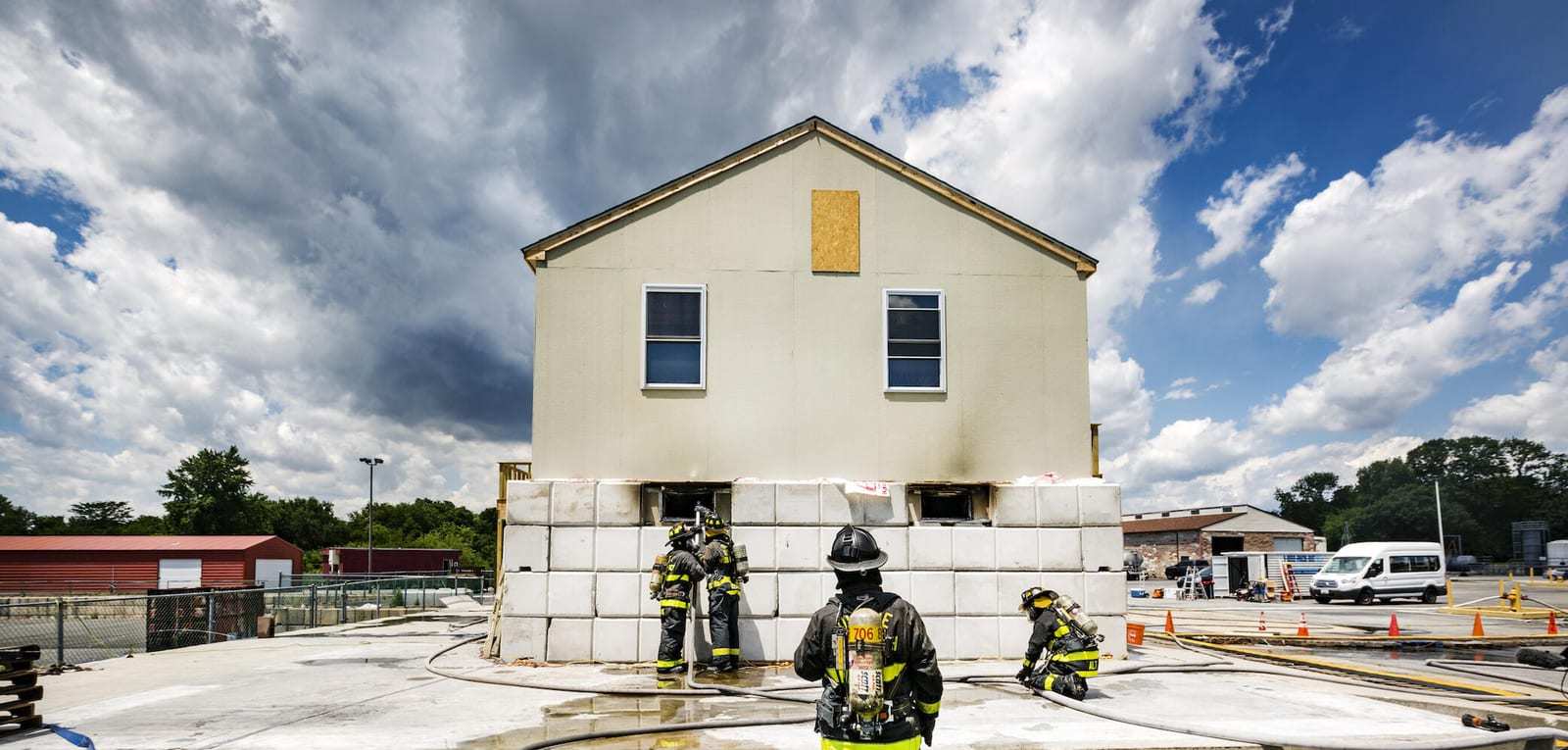
The fire in the living room of a one-story ranch in Northbrook, Illinois, had been burning for eight minutes when researchers opened the front door. In one experiment they left it open. In another they swung it wide, as a crew would to make entry, and then pulled it back to about 4 inches, enough room for a hoseline to lie in the doorway. They ran the same pair of tests in a two-story house with an open great room.

The houses were built for a study by Underwriters Laboratories (UL), whose fire research now runs through UL Research Institutes' Fire Safety Research Institute (FSRI). In both houses the door made the difference. With the door open, more air came in low and temperatures near the floor climbed fast. With it pulled to the width of a hoseline, they held fairly steady. Thermal images from the one-story house showed the bedroom in worse shape two minutes after the simulated crew went in with the door open than four minutes after they went in with the door controlled.
The door is a vent
The researchers ran 17 experiments in the two houses, testing where crews vented, how big the roof holes were and what happened when the door was controlled. Most used modern furniture, and one repeated a modern test with legacy furniture for comparison. The report puts the time between tactical ventilation and flashover at about two minutes for the modern fire and more than eight for the legacy one. A crew venting a modern fire at the wrong moment has about a quarter of the recovery time it had with legacy furnishings.
The report's explanation of door control is simple. A ventilation-limited fire can only release as much heat as its air supply allows. Limit the air and you slow the fire. "The longer and further the door is closed, the slower the fire will grow," the researchers wrote. "The door should be controlled until water is applied to the fire." They also pointed out that doors make the best air inlet in the house because they run all the way to the floor, so air gets pulled in low, where the fire can use it.
The same idea held in real buildings. In FSRI's later coordinated-attack study, researchers burned acquired single-family houses in Sidney and Beavercreek Township, Ohio, and concluded that "opening an exterior door to gain access should be thought of as an important ventilation action."
Fire out a window misleads crews for the same reason. The report found that "fire showing does not mean that the fire is vented; it means that it is venting and still remains ventilation-limited." The flames are outside because there's no air left inside to burn. Open another door or window and the fire inside gets the air it was missing, and every opening sets up a flow path from the inlet to the fire. "Operations conducted in the flow path can place firefighters at significant risk due to the increased flow of fire, heat, and smoke toward their position," the researchers wrote.
The roof hole and the hose
The houses also tested vertical ventilation. A 4-by-8-foot hole over a ventilation-limited fire didn't turn it into a fuel-limited fire in either house. Water did. Once water was on the fire, a bigger hole made things better. The report adds that when the vent is coordinated with water, it matters less where the hole goes, though the closer it is to the seat of the fire, the better it removes heat and smoke.
The water didn't have to come from inside. In the Northbrook tests, about 15 seconds of water through a door or window with fire coming out of it improved conditions throughout the house. In January 2013, the National Institute of Standards and Technology and the International Society of Fire Service Instructors burned houses in Spartanburg, South Carolina, to study flashover, ventilation and isolating the fire. They went back in 2014 to test what's now called transitional attack, which the institute likened to "softening the target": water from the outside first, then the interior push.
A later FSRI study of interior and exterior hose streams added a detail for the nozzle firefighter. Streams only work on what they can reach, so their effect is "limited to line of sight." To keep from pushing air into the fire, the researchers recommend holding the nozzle in a fixed position with a smooth bore or straight stream and keeping the stream short where you can. A fog pattern swept around the room pulls in the most air.
Behind a closed door
Every one of the house experiments included a closed bedroom next to an open one. "Behind a closed door is the most likely place to find a victim that can be rescued," the report says. In every experiment, a victim in the closed bedroom would have survived well past the arrival of the fire department. In the open bedroom, a victim would likely have been unconscious or dead before the engine pulled up, or would have been overcome when crews vented.
That finding became FSRI's Close Before You Doze campaign. Its testing found closed rooms averaging under 100 degrees Fahrenheit while open rooms topped 1,000 degrees. "You could see a markable difference that a person could be alive in a room with a closed door much longer," said Steve Kerber, vice president and executive director of FSRI.
The same applies during a search. The report says doors can be controlled as crews look for the fire or for victims, and "any door that has the potential to feed air to the fire should be controlled until water is on the fire or the fire is contained to a known room." FSRI's study of search and rescue in different-sized homes, designed with a fire service technical panel, starts from the same point: "Isolation by closing doors is critical to occupant survivability and firefighter effectiveness."
The apartment hallway
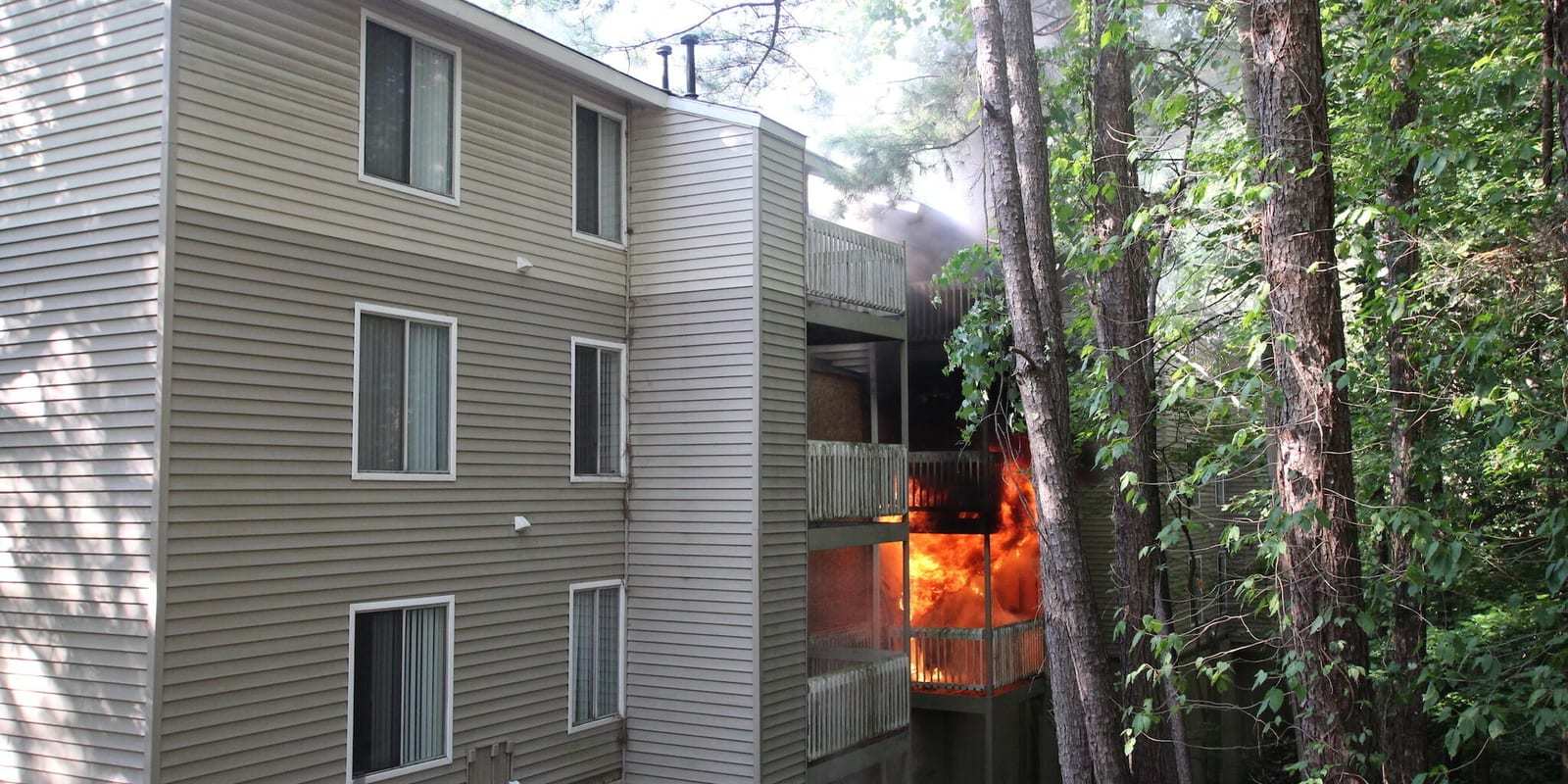
Garden apartments add a problem the single-family houses didn't have: a shared stairwell that everyone in the building uses to get out. In Cobb County, Georgia, FSRI and Cobb County Fire and Emergency Services ran 13 experiments in four 10-unit garden-style buildings. When the fire apartment's door was left open, heat and carbon monoxide filled the enclosed stairwell. Door control, positive pressure ventilation and hydraulic ventilation limited the flow into the stairwell, whether crews used them during suppression or after it.
The crew forcing the apartment door should plan to hold it from the moment it opens.
Decide at the curb
Settle these before anyone masks up:
- Assume the fire is ventilation-limited until it proves otherwise. Fire showing from a window doesn't mean the house has vented.
- Before you force the door, decide who controls it and how. Name a person for the door, and have them hold it to the width of the line.
- If you can reach the fire from outside, put water on it first. Fifteen seconds through the window counts.
- Coordinate the vent with water on the fire. A roof hole or a broken window ahead of water only adds air.
- Close interior doors as you search, and close the door on any room you've cleared or isolated. Put a tool in a door that might lock behind you.
- On garden apartments, keep the unit door controlled until the fire is knocked down so the stairwell stays usable for people coming down from the upper floors.
- Open the door fully once water has the upper hand. Door control is temporary.
If closing the door could keep the crew from getting back out, leave it open and plan for the extra air. "One of the most dangerous places for a firefighter to be is between where the fire is and where it wants to go," the researchers wrote. Practice door control on every hose evolution, so the person on the door knows the job as well as the nozzle firefighter knows theirs.
Sources (9)
Sources
- Study of the Effectiveness of Fire Service Vertical Ventilation and Suppression Tactics in Single Family Homes (UL), 2013
- Occupant Tenability in Single Family Homes Part II: Impact of Door Control, Vertical Ventilation and Water Application (FSRI)
- Study of Coordinated Fire Attack Utilizing Acquired Structures (FSRI)
- Technical report released: multi-family dwellings experiments (FSRI)
- Study of the Impact of Fire Attack Utilizing Interior and Exterior Streams on Firefighter Safety and Occupant Survival (FSRI)
- Study of Fire Service Residential Home Size and Search and Rescue Operations (FSRI)
- Close Before You Doze (FSRI)
- Live burns in Spartanburg, S.C., will benefit research and firefighter training (NIST)
- Spartanburg, S.C., fire experiments will test new firefighting tactics (NIST)